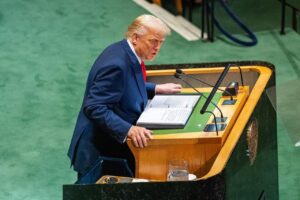
At the 80th United Nations General Assembly in New York, U.S. President Donald Trump stunned the global community by declaring that “climate change is the greatest con job ever perpetrated on the world.” While Trump has long expressed skepticism about global warming and environmental regulation, his speech at the UN marks a decisive escalation: rejecting not only the urgency of the climate crisis but also the legitimacy of international climate cooperation. To many observers, this statement was not an isolated outburst but part of a consistent worldview that ties together economic nationalism, fossil fuel expansion, deregulation, and suspicion of global governance. To fully understand the implications, one must unpack what Trump meant, why he is driven to say it, and how it is shaping the policies of his administration.
What Trump Meant by “Con Job”
When Trump calls climate change a “con job,” he is not simply expressing doubt about rising global temperatures. He is suggesting that the science, the international institutions, and the global movement toward renewable energy are built on deception, waste, and misplaced priorities. His speech ridiculed climate scientists and their predictions, insisting that they had been proven wrong “time and again.” He cast renewable energy transitions as expensive failures, particularly in Europe, where he argued that rising costs and energy shortages prove the folly of abandoning fossil fuels. For Trump, the problem is not only that climate policies are misguided, but that they are intentionally designed to weaken strong economies like the United States by diverting resources toward green technologies and global aid programs.
By framing climate change action as a scam, Trump is constructing a narrative where powerful elites—scientists, bureaucrats, global institutions—are using climate change as a cover to push regulations, redistribute wealth, and erode sovereignty. This framing allows him to justify his administration’s reversals of climate agreements, regulatory rollbacks, and energy expansion policies, while rallying his domestic base around the idea that he is defending the American people from foreign manipulation and elite conspiracies.
What’s Driving Trump’s Position
Several motivations—economic, political, and ideological—push Trump to adopt such a combative stance on climate change.
Economic Interests in Fossil Fuels: Trump has built much of his energy policy around expanding oil, gas, and coal production. By deregulating extraction and limiting restrictions on emissions, his administration is prioritizing short-term economic growth, job creation in traditional energy sectors, and energy exports. This benefits powerful corporate interests that have long supported his presidency.
Deregulation Philosophy: Trump’s political identity is rooted in rolling back what he calls “job-killing regulations.” His climate policies reflect this philosophy by dismantling EPA rules on emissions, weakening the Clean Air Act’s enforcement of carbon dioxide limits, and removing requirements to consider climate impacts in federal infrastructure projects. By rejecting climate science, he also provides ideological cover for these deregulatory measures.
Political Identity and Base Politics: Skepticism toward climate change resonates deeply with parts of Trump’s voter base, particularly in states that rely on fossil fuel industries. Positioning himself against “climate elites” and international institutions also fits neatly into his broader narrative of fighting for national sovereignty and resisting what he portrays as globalist control.
Distrust of Internationalism: Trump’s foreign policy has long been suspicious of multilateralism. By dismissing climate agreements like the Paris Accord as scams or unfair deals, he reinforces his “America First” doctrine. This approach appeals to nationalist sentiment but undermines international cooperation on global challenges.
Policy Reflections – How Rhetoric Turns Into Action
Trump’s “con job” statement is not just rhetoric; it underpins his administration’s approach to climate governance. Several concrete policies illustrate how his views translate into practice:
Withdrawal from the Paris Agreement: Trump has again pulled the United States out of the Paris Climate Accord, formalized in Executive Order 14162: “Putting America First in International Environmental Agreements.” This move signals to the world that the U.S. will not be bound by global commitments to reduce emissions.
Rescinding the EPA’s Endangerment Finding: His administration is moving to overturn the 2009 Endangerment Finding, which legally compels the U.S. government to regulate greenhouse gases as pollutants under the Clean Air Act. Eliminating this foundation would dismantle much of the U.S. government’s capacity to regulate CO₂ emissions.
Rollback of Domestic Regulations: Trump has ordered the Environmental Protection Agency (EPA) to scrap or weaken rules on methane leaks, vehicle fuel efficiency, and power plant emissions. Infrastructure projects are no longer required to consider climate change impacts in their planning.
“Unleashing American Energy” Policy: His signature energy policy encourages maximum exploitation of fossil fuel resources, including drilling on federal lands and expanding pipelines, while simultaneously cutting restrictions on coal and oil.
Together, these policies reflect a systematic attempt not only to stop new climate action but also to reverse decades of progress made under both Republican and Democratic administrations.
Science vs. Trump’s Claims
Trump’s dismissal of climate change as a scam stands in direct opposition to the overwhelming consensus of the scientific community. Reports by the Intergovernmental Panel on Climate Change (IPCC) and the U.S. National Climate Assessment consistently demonstrate that human activity—particularly the burning of fossil fuels—is driving global warming. The consequences are visible: record heatwaves, stronger hurricanes, rising sea levels, and massive wildfires. Green energy technologies are increasingly cost-effective and rapidly expanding, but Trump’s policies risk delaying this transition.
The contrast could not be sharper. While scientists warn that immediate action is required to limit global warming to 1.5°C and avoid catastrophic consequences, Trump dismisses these warnings as false alarms. The result is a widening gap between science-based policy recommendations and the trajectory of U.S. federal policy.
What This Means for Africa
For Africa, Trump’s dismissal of climate change as a “con job” carries particularly harsh consequences. The continent is already facing some of the most severe impacts of global warming despite contributing the least to global emissions. Droughts in the Horn of Africa, devastating floods in East Africa, and the spread of desertification across the Sahel are directly linked to climate shifts. These crises fuel food insecurity, economic instability, and forced migration—issues that African governments are struggling to manage with limited resources.
When the United States, one of the world’s largest historical polluters, retreats from its climate commitments, it undermines the global pool of climate finance meant to help vulnerable regions adapt and build resilience. Trump’s withdrawal from the Paris Agreement not only weakens international solidarity but also delays the disbursement of funds that African nations desperately need for renewable energy investments, sustainable agriculture, and disaster preparedness.
Moreover, Africa’s voice in climate negotiations becomes weaker when powerful nations dismiss the crisis altogether. By branding climate change a “scam,” Trump emboldens other governments to deprioritize climate action, making it harder for African states to advocate for fair climate finance, loss and damage support, and technology transfers. In essence, Africa becomes doubly vulnerable: suffering from the environmental consequences of emissions it did not cause, while also losing the political and financial backing required to adapt.
Conclusion
The importance of Trump’s statement goes far beyond political theatre. By framing climate change as a “con job,” he is actively shaping public opinion, policy, and international relations in ways that could have lasting effects for decades. His administration’s policies not only reverse U.S. climate commitments but also risk slowing global progress at a moment when scientific evidence calls for urgent action.
The world now faces a stark reality: one of its largest historical emitters and most powerful economies has chosen to undermine collective action against the defining challenge of our century. Whether this position proves sustainable, either politically or economically, remains uncertain. What is clear is that Trump’s rejection of climate change as a legitimate threat places the United States at odds with science, with most of the world, and with the urgent need to protect humanity’s shared future. For Africa in particular, this denialism is not just a policy difference—it is a dangerous setback in the fight for survival on the frontlines of climate change.
FOLLOW US FOR MORE: